


How to Choose a Pull-Out Sofa Bed (Without the Regret)
Most pull-out sofa beds are terrible beds. Not all of them, but enough that "how comfortable is it really" should be your first question, not your last.
This guide helps you wake up rested and never have to ask yourself "why does my spine hate me?"
The short version
If you only read one section, read this. The mechanism matters far more than the showroom photo, so check these before you commit:
- Most comfortable = no frame underneath. Like a real bed, you sleep best when no metal bars poke up through the mattress. Frameless modular sofas win here.
- Get a mattress at least 12 cm thick, or you'll feel the frame through it.
- Going with a folding bed? Watch the support bar. It's the metal rod inside the fold-out frame that presses into your back through the thin mattress, and it's the number one complaint. Lie on the open bed in-store to feel where it lands.
- Judge it as a sofa first. You'll sit on it far more often than you sleep on it, so day-to-day comfort matters most.
- Match the size to who actually sleeps on it. A single fits one adult, a double or queen fits two, a corner unit two or three. Aim for around 200 cm length so taller guests fit, and 60-70 cm of width per person.
- Leave room to open it. The bed sticks out well beyond the sofa (80-100 cm further), so check you can pull it out and still walk around.
- Pick a hard-wearing fabric. Corduroy or quality linen both last, and removable covers you can wash or swap keep it looking new.
Bottom line: for occasional guests a good pull-out works. For a sofa you love every day plus a guest bed with no metal bar, a frameless modular like TEDDY is the smarter buy.
The four types of pull-out sofa bed
A pull-out sofa bed is a sofa that converts into a bed, either by pulling a hidden frame out from under the seat or by rearranging the seat pieces flat. The mechanism decides how it sleeps, and "pull-out" gets used loosely for a few different ones:
- Pull-out: a folding metal frame and a thin mattress fold out from under the seat cushions.
- Click-clack: the backrest drops from upright to flat, and the seat cushion itself becomes the mattress.
- Spring pop-up: the seat springs up and forward to form the sleeping surface, common in cheaper models.
- Modular fold-out (like OMHU's TEDDY): the seat pieces you sit on rearrange into the bed, with no hidden frame and no separate mattress to wrestle.
The real choice comes down to two: a frame-based bed that hides inside the sofa, or a frameless modular where the seating is the bed.
Traditional pull-out |
Fold-out modular (TEDDY) |
|
|---|---|---|
Mechanism |
Metal frame + thin mattress folds out from under the seat |
Seat pieces reconfigure into a flat bed |
The metal bar |
Yes, the common complaint |
None |
Sleeping surface |
Thin mattress over a frame |
One even surface, no frame underneath |
Daily sofa comfort |
Often compromised for the bed |
Full sofa comfort, no trade-off |
Storage |
Bed hides inside the body |
No separate bed to store |
Comfort: what to expect
How comfortable a pull-out sofa bed is depends on what sits under the mattress. A thin mattress over a metal frame is fine for a night or two, not for nightly sleep. The thinner the mattress, the more your guest feels the support bars, usually by the second morning.
If you are buying a traditional pull-out, check three things before you pay:
- Mattress depth. Thicker is better. Anything under 10 cm and you will feel the frame.
- Bar placement. Where the support bar lands across your back matters most. Lie on it in the shop if you can.
- Support base. Slats or a tensioned base beat a basic spring grid.
A fold-out modular sidesteps most of this. With no folded frame underneath, the surface stays even, so there is no ridge running across anyone's back at 3am.
Can you sleep on a pull-out sofa bed every night?
You can, but most traditional pull-outs are not built for it. The thin mattress and metal frame are fine for occasional guests; for nightly sleeping they wear on your back fast.
If someone needs a real bed every night, buy an actual bed. If you need a sofa that handles guests a few times a month, a quality pull-out or a fold-out modular both work. For the everyday-bed case, a fold-out modular surface gets closer to acceptable than a frame-and-thin-mattress pull-out, because there is no bar to sleep around.
Are pull-out sofa beds bad for your back?
The bad ones are, and the reason is mechanical: a thin mattress laid over a folding metal frame leaves a hard support bar sitting right under your spine. That bar is the single most common complaint about a sofa with a pull out bed.
This is not just anecdotal. A randomised controlled trial in The Lancet found a medium-firm mattress eased pain and disability more than a firm one for people with chronic low back pain, and a 2021 systematic review reached the same conclusion: a supportive, even surface matters most. A thin pad stretched over a folding bar is the opposite of that, which is why the cheapest pull-outs are the hardest on your back.
You can reduce the problem on a traditional pull-out:
- Choose a mattress of at least 12 cm so the foam masks the frame.
- Add a mattress topper for guest stays (more on that below).
- Pick a model where the support bar sits low or toward the edges, not mid-back.
Or you avoid it entirely. A fold-out modular has no folding bed frame underneath, so there is no bar to dig in. TEDDY uses metal bars only as connectors between the modules, not as a sleeping surface, so nothing presses into your back.
The frame: steel vs wood
For a sofa bed that sees guests a few times a month, steel usually wins on longevity because it resists bending under repeated opening and closing. Wood feels more solid under daily sitting, but the joints can loosen once a heavy mechanism gets regular use.
Steel frame |
Wood frame |
|
|---|---|---|
Repeated folding |
Handles frequent open/close, resists bending |
Joints can loosen with heavy use |
Feel |
Firm, mechanical |
Solid and sturdy |
Longevity (guest use) |
Usually longer, if thick-gauge |
Good, but inspect the joints |
Watch out for |
Thin steel twists faster |
Loosening over time |
Whichever you pick, check the joints and welds in person. Thin steel twists faster than thicker stock, and that is hard to see in a product photo.
Worth saying plainly: this whole steel-versus-wood question only applies to traditional pull-outs that hide a folding bed frame. A fold-out modular like TEDDY has no folding frame to bend, loosen or dig into your back, because there is no bed frame in the first place. You are not lying on a frame at all, you are lying on the same dense seat foam you sit on every day, so it feels much closer to a proper mattress than to a metal contraption. If the frame question is what worries you, the modular route removes it entirely.
The mattress: memory foam vs innerspring
Memory foam contours to the body and eases pressure points but can trap heat and feel slow when you roll over. Innerspring bounces back faster and breathes better, but it tends to bottom out sooner on the thin profiles used in pull-outs.
Memory foam |
Innerspring |
|
|---|---|---|
Feel |
Contours, eases pressure points |
Bouncier, quicker response |
Temperature |
Can trap heat |
Sleeps cooler, more airflow |
Rolling over |
Slower to respond |
Fast |
On thin profiles |
Fine if thick enough |
Bottoms out sooner |
Best for |
Side sleepers, pressure relief |
Hot sleepers, restless movers |
The practical answer for occasional use is a hybrid: foam layered over coils. Aim for at least 12 cm total thickness, or you will feel the frame regardless of type. A medium-firm result is also what the back-pain research above points to, so avoid anything that feels either rock-hard or sink-in soft once it is open.
Sizes and dimensions
Most pull-out sofa beds open to a full or queen surface around 140 to 160 cm wide and roughly 200 cm long. Twin or single versions sit closer to 90 cm wide. A sectional can reach king proportions in larger configurations.
Size |
Approx. width |
Length |
Extra depth needed when open |
|---|---|---|---|
Twin / single |
~90 cm |
~200 cm |
+80 to 100 cm beyond the closed sofa |
Full / queen |
~140 to 160 cm |
~200 cm |
+80 to 100 cm |
Sectional / corner |
up to king |
varies |
check the maker's extended specs |
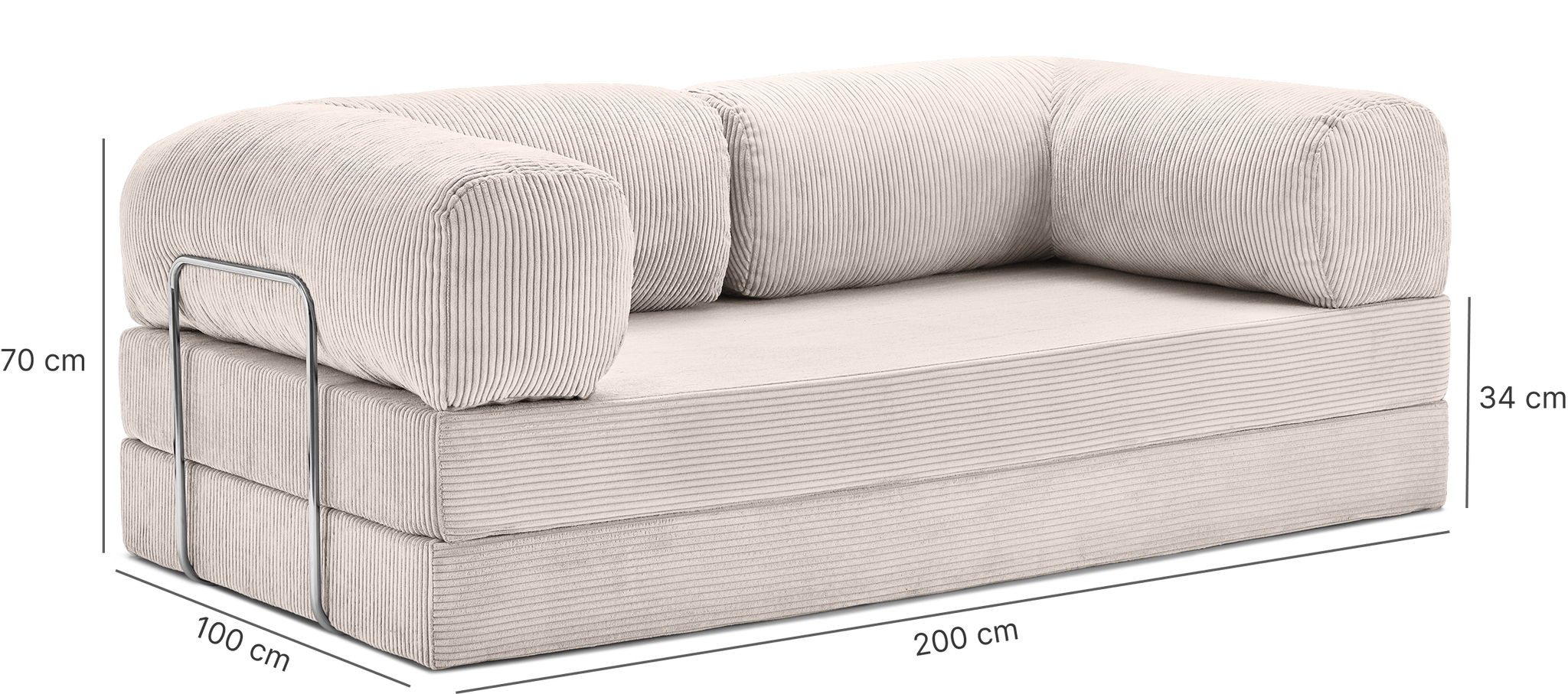
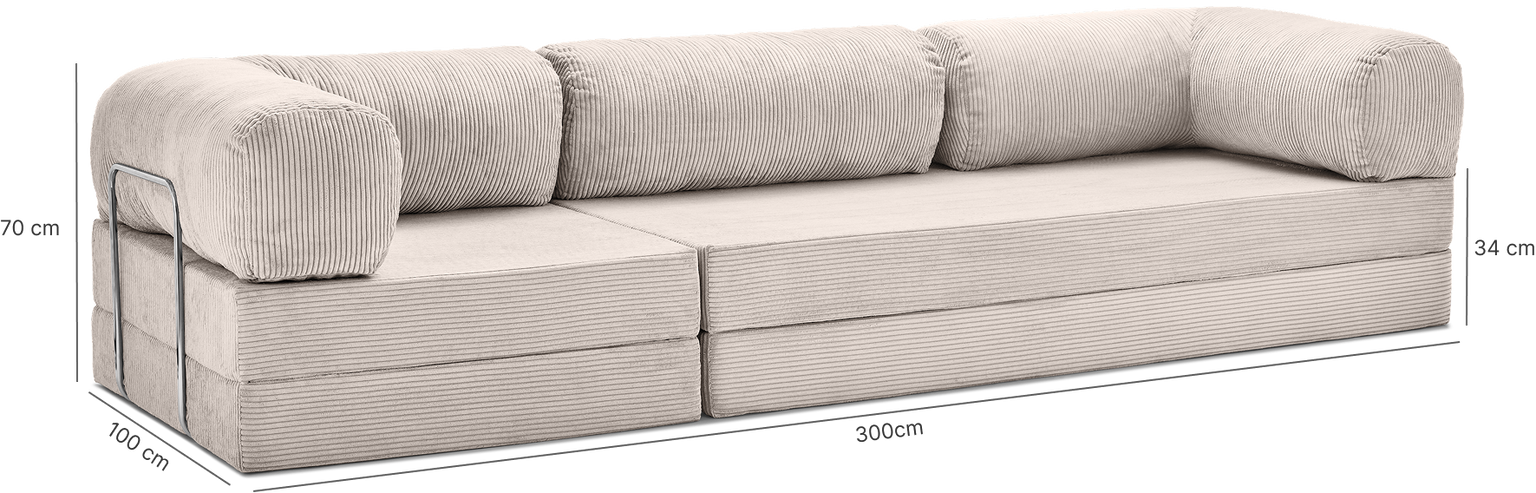
With TEDDY you size the bed to your room instead of forcing your room around it.
TEDDY Sofa: a 2-person sofa and a bed for one or a cosy two.
TEDDY Plus: more sofa, more sleeping surface.
Corner Open / Corner Closed: for bigger rooms or more sleepers, the natural answer if you would otherwise be eyeing a sectional sofa with pull out bed.

How many people it sleeps
How many people can sleep on a pull-out sofa bed comes down to the open width: a single or twin sleeps one adult, a full or queen sleeps two, and a corner or sectional can sleep two to three depending on the configuration.
Open size |
Approx. width |
Comfortably sleeps |
Width per adult |
|---|---|---|---|
Single / twin |
~90 cm |
1 adult |
~90 cm |
Double / full |
~140 cm |
2 (cosy) |
~70 cm |
Queen |
~150 to 160 cm |
2 |
~75 to 80 cm |
Corner / sectional |
up to king (~180 cm) |
2 to 3 |
varies by layout |
Measurements to keep in mind before you buy:
- Length: most beds open to about 200 cm, which suits sleepers up to roughly 190 cm. Many pull-outs scrimp on length, so check the exact figure if a tall guest will use it.
- Width per person: allow 60 to 70 cm each for comfortable sleep. Two adults on a 140 cm surface is cosy, not spacious; aim for a queen if you want real shoulder room.
- Mattress depth: 12 cm or more so nobody feels the frame, whatever the width.
- Open depth: add 80 to 100 cm beyond the closed sofa, and check that against your floor space (see the clearance section below).
- Doorway and access: measure the sofa's smallest dimension against your narrowest door, hallway and stair before ordering. A modular that arrives in pieces solves most access problems on its own.
Space and clearance
A pull-out sofa bed needs more floor space than its closed footprint suggests. Measure the extended depth, not just the sofa's footprint, and leave clearance in front to fold it out and walk around it. Many pull-outs roughly double their depth when open, often adding 80 to 100 cm.
A sofa that fits neatly against the wall can swallow half your living room once the bed is out. Plan for a clear path around the open bed, otherwise your guest is climbing over the coffee table to get in.
Making it more comfortable
The fastest way to make a pull-out sofa bed more comfortable is a mattress topper, which adds the depth the thin sofa-bed mattress is missing and dampens the frame underneath. A 5 to 8 cm foam or hybrid topper turns a one-night surface into something a guest can manage for several.
Other quick wins:
- Use a proper fitted sheet so the topper does not slide off the frame.
- Add a mattress protector to stop the thin mattress absorbing spills.
- For frequent guests, store a rolled topper nearby so setup stays a two-minute job.
A fold-out modular needs less of this, because the surface is already even seating-grade foam rather than a thin fold-away mattress.
The fabric: linen vs corduroy
On a piece that doubles as a bed, choose a tough, forgiving fabric, because more bodies, more handling and the odd late-night water glass all land on it. Corduroy and quality linen are both strong choices; the difference is feel and upkeep.
Corduroy |
Linen |
Velvet |
|
|---|---|---|---|
Durability |
High, hides marks well |
High if tightly woven |
Medium, shows pressure marks |
Feel |
Warm, soft ridges |
Cool, crisp, breathable |
Plush, can flatten |
Hides everyday wear |
Yes |
Moderate |
No |
Main drawback |
Collects crumbs in the ridges |
Wrinkles and creases |
Marks and crushes easily |
Best for |
Daily use, families |
A lighter, airy, natural look |
Statement pieces, lower traffic |

If you want one objective number, ask for the fabric's Martindale rub count, the result of the ISO 12947 abrasion test. As a rule of thumb, 15,000 to 25,000 rubs suits a normal family sofa and 25,000+ covers heavy use or homes with pets. A good corduroy or upholstery-grade linen will sit comfortably in the durable range.
While you are at it, check the piece meets your market's furniture fire-safety standard (EN 1021 in the EU, the Furniture and Furnishings Fire Safety Regulations 1988 in the UK).
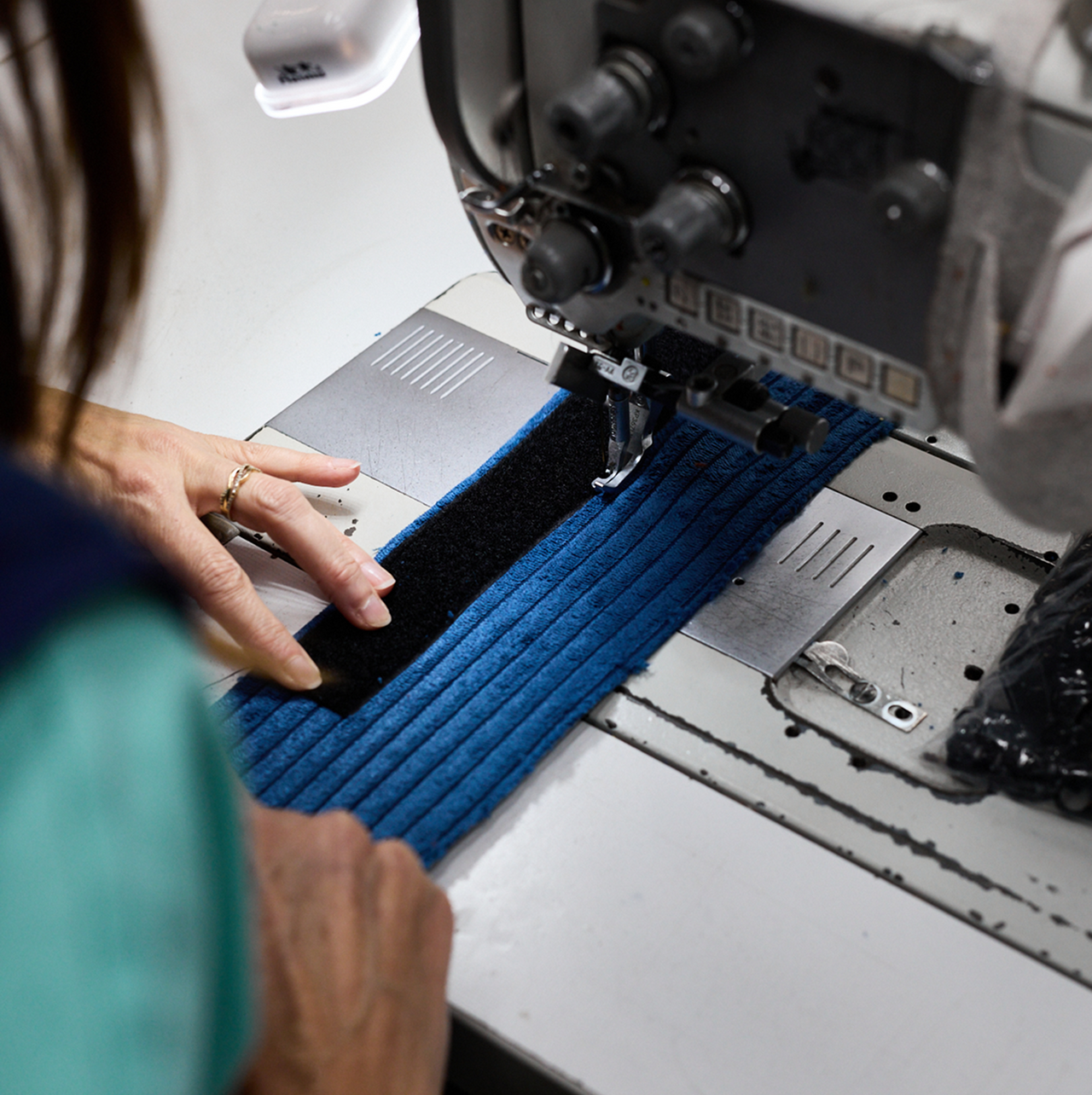
Corduroy is what TEDDY uses: warm under the hand, soft to sit on every day and good at hiding marks. Linen is the alternative most buyers weigh against it, prized for a cooler, more breathable and more natural look, though it wrinkles more easily and shows marks more than a textured weave does. Whatever the fabric, washable or replaceable covers matter most, because you fix the look instead of replacing the sofa.
For colour, go practical:
- Slate or Rust: hide everyday wear and the occasional guest mishap.
- Cream White: keeps a room calm and light, but asks for a bit more care.
Darker and warmer tones forgive more. Pale tones look great and need a little more attention.
Cleaning and care
A sofa that is also a bed gets handled twice as much, so easy cleaning is not optional. Three habits keep it looking right:
- Remove and wash the covers rather than scrubbing stains in place.
- Vacuum the fabric with a brush head to keep corduroy ridges crumb-free.
- Spot clean fast so spills do not set.
TEDDY covers and pillows are replaceable accessories, so the piece ages with you. Worn cover, new cover, and the sofa keeps living instead of heading to the curb.
How long they last
A pull-out sofa bed from a solid maker usually holds its shape for 7 to 10 years with regular guest use. The mechanism wears first on cheaper steel frames, while better frames keep working past the decade mark.
Frame warranties often run around 5 years; cover warranties less. Beyond any manufacturer warranty, EU buyers also have a minimum two-year legal guarantee on goods, so a sofa bed that sags within that window is a claim, not just bad luck. Lighter budget models (the kind you find searching "sofa with pull out bed ikea") tend to sag sooner than a heavier modular system, because the components start out lighter. With replaceable covers, the surface you see can outlast the frame entirely.
What it costs
A pull-out sofa bed costs anywhere from under €600 to €3,000 or more. The mechanism and the frame are the two biggest drivers of the gap, with the mattress and fabric close behind.
Price band |
What you typically get |
|---|---|
Under €600 |
Basic click-clack or entry pull-out, thin foam, softwood frame. Fine for rare guests, shorter lifespan. |
€600 to €1,500 |
The mainstream sweet spot: proper fold-out mechanism, 10 to 12 cm mattress, decent frame and fabric. |
€1,500 to €3,000 |
Premium territory: hardwood frame, pocket-sprung or thick foam, better fabrics and longer warranties. This is where a piece is properly good at both jobs. |
€3,000+ |
Specialist and designer pieces, premium mechanisms, bespoke options. |
A few things worth knowing before you compare prices:
- The cheap-at-both trap. The sub-€600 models that try to be an equally good sofa and bed usually fail at both. If budget is tight, decide which function matters more and buy for that.
- Add-ons stack up. White-glove delivery, an extended warranty and a mattress topper can each add €50 to €200, so factor them into the real total.
- Where modular sits. A quality fold-out modular lands in the mid-to-premium band, but it earns it differently: you are buying a sofa you use daily plus a guest bed, not a compromise that is mediocre at both. Replaceable covers also stretch its working life well past the frame.
Pull-out vs fold-out modular
Buy a traditional pull-out if you need to hide a bed in a tight space and host overnight guests only rarely. Buy a fold-out modular if you want a sofa you genuinely enjoy every day and a guest bed without the metal bar.
What matters |
Traditional pull-out |
Fold-out modular (TEDDY) |
|---|---|---|
Sleeping comfort |
Thin mattress over metal |
Even surface, no bar |
Daily sitting |
Often a trade-off |
Full sofa, comfortable daily |
The metal bar |
The #1 complaint |
None |
Setup |
Wrestle the frame out |
Rearrange the cushions |
Storage |
Bed hidden inside |
The seating is the bed |
Best for |
Rare guests, minimal space |
Daily sofa plus regular guests |
You sit on it roughly 360 days a year and sleep on it maybe 20, so judge it as a sofa first. This is where modular wins quietly: the pieces do both jobs, so you are not trading daytime comfort for the occasional overnight.
The verdict: are they worth it?
A pull-out sofa bed is worth it if you have real overnight guests and limited space. Less worth it if you want something to sleep on every single night, where a proper bed will always win.
For occasional guests, a sofa bed with pull-out earns its place. If you want both a good sofa and a workable bed without the classic downsides (the metal bar, the wrestling, the saggy mattress), a fold-out modular like TEDDY is the smarter pick. You get a sofa you will happily use daily and a sleeping surface that does not feel like a punishment.
FAQ
Do pull-out sofa beds come with a mattress?
Yes, almost all pull-out sofa beds include a mattress, but it is usually thinner than a standalone one, often 10 to 14 cm.
Check the depth before buying and aim for at least 12 cm, since anything thinner lets you feel the metal frame underneath. If your model's mattress is thin, a 5 to 8 cm topper makes it comfortable enough for guest stays.
Can two people sleep on a pull-out sofa bed?
Yes, two adults can sleep on a full or queen pull-out sofa bed, which opens to roughly 140 to 160 cm wide, the same as a standard double.
Allow about 60 to 70 cm of width per person for comfort. Single and twin versions, around 90 cm wide, suit one sleeper only.
Most beds are about 200 cm long, which fits sleepers up to roughly 190 cm.
Are pull-out sofa beds good for small apartments?
Yes, pull-out sofa beds are well suited to small spaces and apartments because they combine seating and a spare bed in one footprint.
The catch is the open size: the bed can roughly double the sofa's depth, adding 80 to 100 cm, so measure the floor space in front and check you can still walk around it once it is out. A modular sofa bed helps here, since you can match the exact footprint to the room and it usually arrives in pieces that fit through tight doorways.
Are fold-out modular sofas more comfortable to sleep on than pull-outs?
Usually yes.
A fold-out modular sofa has no folding metal frame hidden underneath, so there is no support bar pressing into your back and the sleeping surface stays even. You lie on the same dense seat foam you sit on, which feels closer to a proper mattress than the thin pad over a frame found in most traditional pull-outs. A high-end pull-out with a thick mattress can close the gap, but the modular avoids the problem by design.


